From the Archive — Athena Magic: The Shoes, Hat and Parasol
 Athena Magic was never just a dress.
Mum designed it as a complete racewear ensemble, and every part of it had to belong together — right down to the shoes, the hat and the parasol.
Looking back at it now, I sometimes think Mum may have watched My Fair Lady a few too many times. The full skirt, the hat, the matching shoes and the parasol certainly had a little touch of Ascot about them.
The shoes were colour-matched by hand. Mum used the type of spray paint normally used by florists, layering white and blue until she achieved the right shade to match the dress.
Close enough was never really close enough for Mum.
The hat was built on a teardrop-shaped base designed to sit just before the devil’s peak back.
Mum always referred to the foundation material as horsehair. It was a heavy woven material that she stiffened and shaped herself, then covered with the same blue jersey used in Athena Magic. Underneath, she lined it with lightweight cotton so the woven base would not catch in the wearer’s hair.
The sculptural swirls were made from crinoline.
Even now, after looking through countless millinery supplies, I have never found that exact shade of blue again, so how Mum achieved such a close colour match remains one of those little mysteries.
Around the edge of the hat she used the same pearl trim that appeared on the dress.
From the back came three large leaf-shaped wire forms, each threaded with pearls, giving the hat height and movement while carrying the pearl detail through the whole ensemble.
To finish it, she added Russian netting over the face.
Then there was the parasol.
For reasons I still do not entirely understand, Mum did not buy one umbrella.
She bought a box of them.
We had pink ones, blue ones and black ones — probably around fifty umbrellas all up.
Dad, Ian, ended up becoming part of the parasol story too.
After Mum had gone through a few attempts, Dad made the handle you can see in the photographs.
It started life as a broomstick.
He had to partially hollow it out so the end of the umbrella could fit inside, then taper it and turn it to shape. Turning timber like that was not something Dad had ever done before, but that certainly did not stop him.
If you knew Dad, you would know he could make something strong enough to survive a world war.
Polish, however, was not necessarily his priority.
Mum had other ideas.
Once the handle had been shaped, it was finished and painted in oil paint so it could withstand the amount of handling Athena Magic would receive on the runway. The colour was matched to the rest of the ensemble as well.
Dad made it to last.
Mum made sure it matched.
There were definitely a few arguments along the way.
Covering the parasol itself took many more hours.
Mum knew that under runway lights the light would shine through the fabric, so every seam and every line would be visible.
She cut the jersey in the same way she had cut the skirt, arranging the satin lines so they formed arrow shapes through the panels. Every line had to meet perfectly, without a pucker.
In the photographs, particularly where the light shines through the parasol, you can actually see just how carefully those lines were matched.
The parasol was finished with three frills — one at the spike at the end and two around the main outer edge, with one sitting slightly offset from the other.
It was not simply an umbrella covered in matching fabric. It was designed as part of Athena Magic.
Years later, the pieces of the ensemble gradually disappeared.
I last remember seeing the dress around 1998. The hat stayed around a little longer, although after so much handling it was beginning to become a little wonky.
The parasol, however, survived much longer.
After Athena Magic had finished its competition and runway life, Mum kept it on display as her prototype. She went on to make other parasols for customers, so this one became the example she could show people when discussing what was possible.
Every now and then, if Mum was heading outside into the sun, she would even take it with her and use it for shade.
It had already travelled around Australia, appeared on around fifty catwalks and done the job it was originally created to do, so becoming a showroom sample — and occasionally an actual sunshade — gave it a very practical second life.
The parasol was still there when we eventually packed up and sold Sandringham.
I’m fairly sure I sold it for around $50 in the closing-down sale.
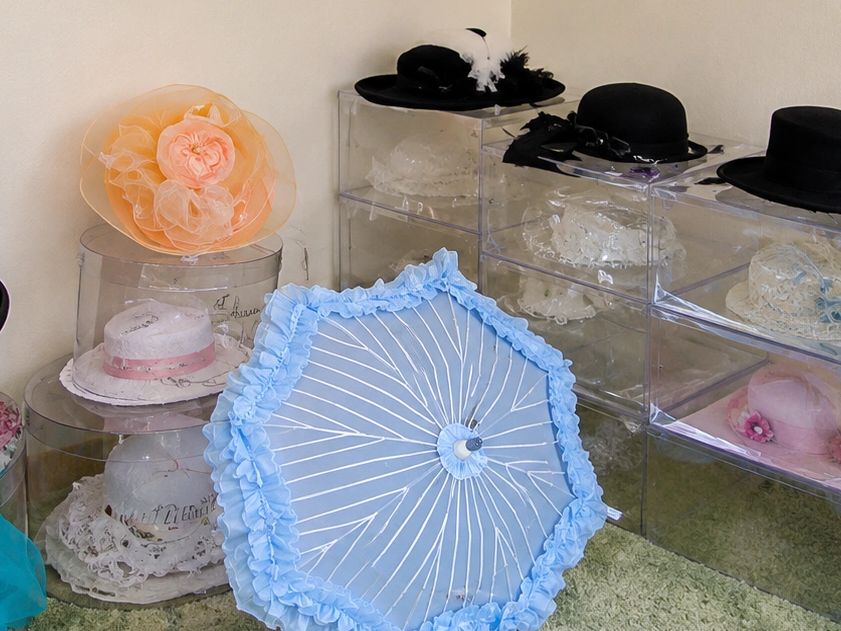
After all the hours Mum and Dad put into it, all those runways, all that careful matching and all those umbrellas, it may well have been the last surviving piece of Athena Magic to leave us.
And given how many umbrellas Mum originally bought, it is probably just as well she found a use for them.
Otherwise, we might still have a lot of umbrellas today.
Designed by Hand. Defined by Heritage.
#BatemanOriginalDesigns #AthenaMagic #SheilaBateman #AustralianFashionHistory #Racewear #Millinery #FashionHeritage #AustralianDesign #DesignedByHandDefinedByHeritage